The Unwatched Years - Social Media and Childhood...(18.6.26)
And so… the government is going to ban under-16s from the main social media platforms. The reaction has been about what I would expect. Plenty of privacy concerns about age verification (which I share). Worries about state authority over digital life (very much shared). Scepticism about whether teenagers will simply find workarounds (many will). Parents' groups split. The tech companies issue statements about safety while lobbying against any specific measure that would reduce their reach.
Of course these are all valid concerns. But the debate mostly centres on the question of whether the ban will work, which is downstream of the crucial question that the policy actually has to answer: Are platforms appropriate developmental environments for children at all?
I find myself in favour of the ban, despite not liking bans much and thinking that the means of implementation will probably fail on their own terms. Worse, I expect the solutions will include an overreach allowing monitoring of all social media use for adults too - another step towards a low-grade surveillance state. To avoid that, solutions must come from 'hardware' rather than 'software verification' steps such as proving your age and identity by signing in. If they don't then companies will simply release a load of new apps for children that are not banned that serve the same purpose, while adults lose basic anonymity online. Legislation will always lag behind innovation, and kids move more quickly than politicians. Nonetheless, despite my own instinct not to ban things, I think the underlying decision is sound, and the structural reasons for that instinct should be said plainly.
Jonathan Haidt and Zach Rausch have done a lot of great work over the last few years collating the evidence on social media and adolescent mental health, and their seven lines of evidence piece on After Babel is the best single corralling of the material that I've come across. If you want to know more, that is where I would point you.
The evidence has now converged across many different methodological directions. What young people themselves report, what parents, teachers and clinicians say, what tech company insiders have admitted, what randomised reduction experiments demonstrate - all pointing the same way.
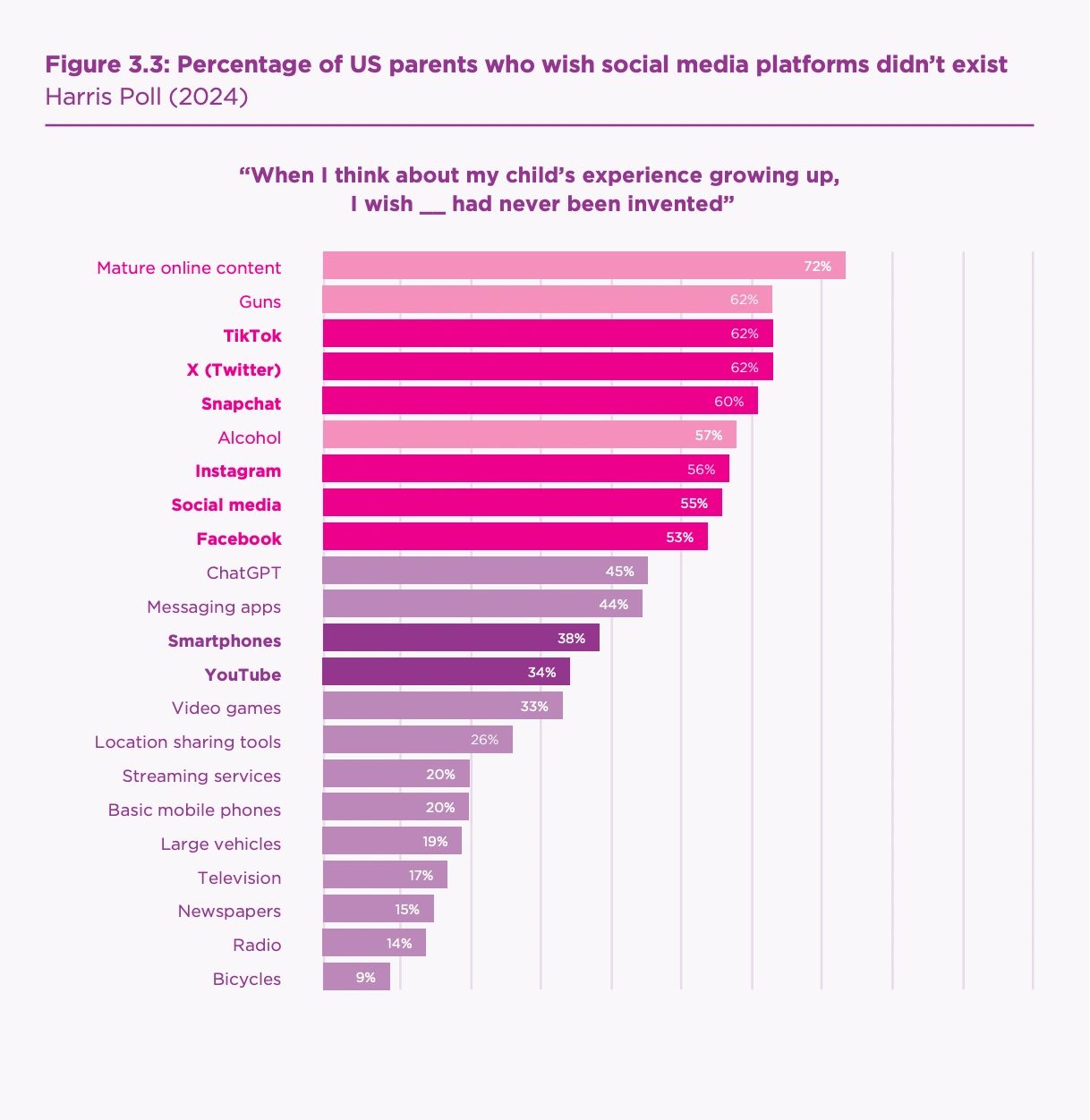
Heavy adolescent social media users are in worse mental health than light users, with effects particularly pronounced among girls during puberty. Reducing use consistently improves anxiety and depression. The spread of social media lines up with worsening youth mental health across countries.
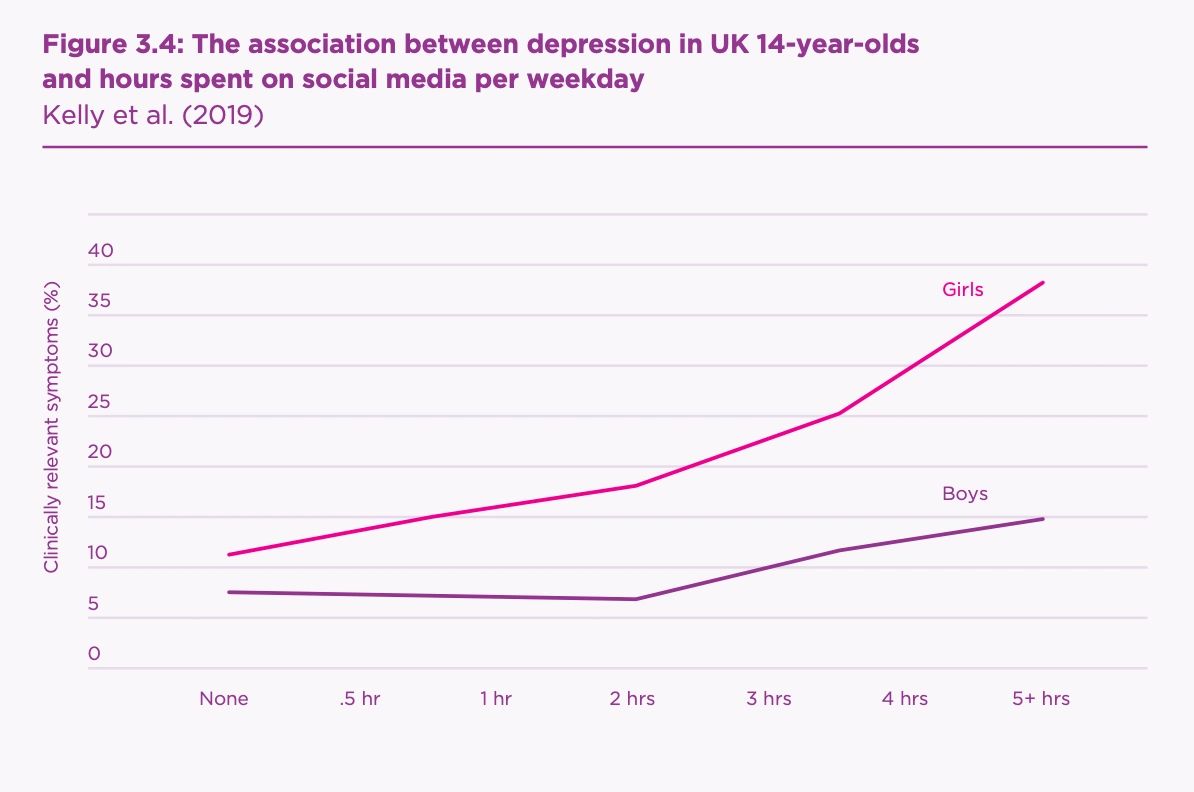
Boys and girls use social media differently. Any parent with teenage girls in their life will know (or be able to extrapolate even if your own children are exceptions) that huge, formative amounts of time are simply spent looking at other teenage girls pouting and talking into the camera on TikTok. I personally don't really care what the content "actually is" - it amounts to an endless stream about beauty or relationship-related things that are ultimately to do with bodily appearances. Years are lost to this in some families, right over formative times when children ought to be learning about the world and developing interests. Boys have their version of this, and many people have pointed to the impact of the "manosphere" or believing they must "hustle" that takes root for some in these teenage years. At times this has taken over the national debate (see Adolescence and Manosphere posts).
While no single study in the Haidt link is perfect, the convergence is now substantial enough that "we do not yet know" has become a bad defence. We know enough... And so it's vital for us all to understand the miserable costs of the social media experiment and the impact on young people, so we can ensure it never happens again.
The social media experiment (and it most certainly has been an experiment) robs children of the central function of childhood - that it is allowed to be experienced, and that it is allowed to disappear... The very thing that childhood is for is to safely learn about the world without leaving a permanent public audit trail.
Using myself as an example, most of what I did between the ages of six and eighteen is gone, existing only in my mind and the minds of others who happened to be there at the time. A few photographs survive, some of which were coincidentally returned to me this week. Some stories might survive a retelling at family gatherings, and may or may not be accurate (hard to say after a few decades). But all else has dissolved into the ordinary forgetting that childhoods used to undergo. The phases I went through, the stupid things I might have said, the obsessions, the embarrassments, and so on. Thank God I don't need to explain or defend it all publicly or have it follow me about. And things being "gone" was part of how it worked before social media.
I think we have underestimated the role of "disappearance" for healthy development. The child who said something foolish at twelve wasn't absolutely stuck with it. The peer group's memory was bad and the audience was small, so within a year or two the stupid-kid thing had faded enough that the child could reinvent themselves. Nobody could accurately keep score. The whole social environment had a built-in amnesia that was developmentally generous and gave you somewhere to grow without being asked to account for every step.
The pre-platform child was allowed the mercy of being temporarily ridiculous. The platform-formed child isn't. That's one problem.
But, let’s face it, the real problem is not “young people creating content that then follows them around for all time”. Those are the outlier exceptions constituting a tiny percentage. You might say at least this cohort are actually doing something, even if it proves to be fairly skin-deep and mindless. The true weight of the problem lies in consumption. It’s young people becoming captured by screens and becoming accustomed to zombie-like consumption and little else, which can take on forms similar to all other addictions over time, impacting mood and wellbeing.
Both problems are more important than the standard "product-harm" framing tends to capture. The contemporary child is being developed inside a consumption environment that is doing things to them, hour after hour, year after year, without their being able to notice or resist what is happening. They sit, outside of any conversations happening around them, absorbing endless content that is steadily reshaping how they think, what they want, who they are comparing themselves to, and what the world appears to contain... The shaping happens beneath the level of explicit awareness, and by the time the child is old enough to think about what has happened to them, the shaping has already done most of its work. In a real sense, these children don’t know what they have lost. And we now have a generation of young people, let's estimate 25 and under, who have known nothing but this environment.
The crucial loss is the habit of attending to what is around you. The ordinary, small, countless, organic instances of unprompted attention are how children used to build the inner mental map that adults later draw on without being aware of it. Being plugged in to conversations in the home (even earshot involvement), understanding the concerns of Mum and Dad, the countryside, the city, the weather, the way people move through public space, the small mechanical curiosities of how things work, the differences between people and places. The list is endless because it includes literally everything.
Without these myriad reference points, how do children begin to make links between (or cultivate any interest in) their present? And if the present is unknown except via whatever your feed gives you onscreen, what value has the past? It's a waste of time. Or the future? How can you begin to track your environment over time if you never even begin to track? How then can you begin to develop the kind of inner-scaffold that allows you to make judgements of what is good or bad? Better or worse? Important, or not? Or, sometimes, right from wrong.
How can you learn about the world if you never look up? The answer since 2007 seems to be "you'll learn what the screen shows you".
A small (anonymised) example. A young woman I worked with mentioned that she was learning to drive. The driving was not going as smoothly as she had expected. She’s picked up the control of the car quickly enough, but not so the world outside the car. The names of the things you pass, landmarks and so on. Her home town is unknown to her, what roads lead (even roughly) where and what the basic areas are called. How junctions work. Whether to "stay", "go", and how to navigate in ways you have seen parents do a thousand times if you had been looking up. Where other drivers might be coming from. Traffic lights and how they actually work from behind the wheel. As we talked it became clear that she had spent most of her childhood on car journeys without really looking out of the window. The phone had been more interesting than the window and was always in her hand. Year after year. The cumulative effect was that the basic mental map that previous generations built up without noticing was simply not there. She was having to build it now, in her twenties, from scratch.
She wasn't failing at anything and was working hard. But it gave me pause about what had happened in those years, and about how typical the pattern probably is in a generation that grew up with the phone.
I suspect the true consequence of excessive social media during childhood is something like an epistemic thinning. Broad, ambient knowledge of the world has shrunk in the generation that grew up inside the platforms. People under twenty-five, on average, may now know less about the world than people their age would have known thirty or forty years ago. That may be the first time in human history we can say this. There has been an outsourcing of "knowing" things for "checking" things, something teachers tell me they see clearly as children move through school. The knowledge itself is still there, curated and searchable and algorithmically returned if someone asks, but no longer resides within people as a broad base of general knowledge, as it did. Without that base, basic judgement becomes more prone to fantastical ideas, less connected with the complexities of reality, and selected by algorithm (and who controls that exactly?).
In Moral Singularity I wrote about inner ontological flattening, in the context of adults living inside closed institutional cultures. The chapter argues that when a moral environment supplies only a narrow range of permitted interpretations (moral opinions), the inner field begins to contract to match. Ambiguity - or difference - stops being available as a feature of mental life, and disagreeing with the moral opinion you are shown begins to feel dangerous. The mind contracts to reduce internal risk. I wrote there:
"As the inner field narrows, certain distinctions stop being available. A feeling is no longer something that can be explored over time; it must be identified at once. Ambivalence loses its status as a normal feature of mental life and begins to feel like a flaw. Curiosity becomes difficult to sustain because it opens paths that do not guarantee moral clearance."
I was thinking about adults inside closed institutional cultures when this was written. Therapists working under increasingly prescriptive ethical frameworks. Professionals navigating activist-coded workplaces, and so on. People whose interior life had come to feel like territory that had to be policed because the surrounding moral environment did not tolerate certain kinds of inner experience.
This structural argument applies to platform-formed children too, and in some ways more powerfully. The adult inside a closed institution had years before the closure to develop their own inner landscape. The narrowing happens to them. The child growing up on platforms has the narrowing happen instead of the landscape, and thus the narrowing is native. They never build the inner picture in the first place, because the conditions under which an inner picture forms have been displaced by the platform's constant supply of pre-formed interpretive content. Their locus of interpretive and moral control crystallises outside them rather than inside them.
This is where, for readers who have followed recent output, the Moral Singularity framework starts to do work that other explanations don't reach. Platforms are not just delivering closed positions to children. Platforms are training children in the very mechanics by which positions close in the first place...
The conviction cascade operates algorithmically. The legible moral position - easily readable, easily shared, easily aligned with - is rewarded with engagement; the position that introduces friction is punished with silence or attack. The child learns to read the room before they speak, without anyone teaching them to do it. The master moral language is acquired as native vocabulary, before the child has read the books, encountered alternatives, or developed the capacity to distinguish vocabulary from analysis. Before they have looked up.
Alongside this, the refusal to rank is built into the platform itself, since everything appears as equivalent content and offence becomes the only available form of moral evaluation. Disagreement on the platform tends to be sorted as bad faith or misunderstanding rather than as legitimate objection. This is the interpretive ratchet operating at speed and at scale, on children too young to recognise what is happening to them.
By the time the platform-formed child reaches adulthood, the mechanics are already inside them. Trying to recognise and resist them later, as an adult, is harder for someone who learned them as their first language.
The standard objection to all this is that families should manage it. Parents should set limits, model good behaviour and talk to their children about what they encounter. Fine. But this treats platforms as essentially neutral environments that parents need to help children navigate, whereas the structural case suggests the environments are not neutral. They are designed, with substantial engineering expertise, against the developmental work parents are trying to do. A parent who tries to teach their child to look up, think critically, change their mind in response to evidence, and tolerate disagreement is fighting an environment that systematically rewards the opposite. The parent can win some battles, but they can't win the war if the war is being fought on terrain the platform controls.
This is where collective action becomes legitimate. We don't let casinos market to children because we have decided as a society that certain environments are not appropriate for developing minds and we do not require every family to fight that battle individually. We make the judgement structurally and accept that enforcement will be imperfect.
The social media question is in the same category. The question is whether the underlying judgement is sound: that platforms as currently constituted are not appropriate developmental environments for children. I think the judgement is sound, and the developmental case for it goes well beyond the empirical harm case that Haidt and others have made so well.
In the end, this is all about protecting the capacity to grow up into a particular kind of adult. The adult who had the space and privacy to look up, to learn the world, to occasionally develop slowly and messily. That kind of adult is more likely to be capable of the things sustained life requires. A broadness of thought, and a base of knowledge that allows a person to think. The capacity to make sustained moral judgements on grounds other than the feelings they produce. The capacity to carry one's own inner picture of the world rather than relying on an externally supplied one at all times.
Whether the ban currently proposed will work as intended is open for debate. As I’ve said, I think it will likely introduce serious problems. But children deserve some years before the screens. Time to look up, time to be ridiculous, time to build a picture of the world from the world itself. The least we can do is try.
---
Steve Perkins is a Consultant Psychotherapist and Clinical Supervisor in private practice in Shoreham-by-Sea and the City of London. He is the author of Moral Singularity: Life Inside Closed Moral Worlds and Why Moral Conversation Breaks Down (2026), and writes on therapeutic enclosure, conviction cascades, the interpretive ratchet, and the structural dynamics of closed moral systems.
MBACP (Accred)
www.whitestonetherapy.com


Comments
Post a Comment