Manosphere...(18.3.26)
Manosphere...(18.3.26)
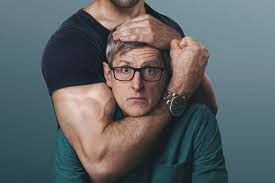
A client asked me last week if I had watched the new Louis Theroux documentary "Inside the Manosphere". To be honest, I hadn't but felt I should have. I'd probably would have skipped it altogether as I felt sure it would follow the incurious formula that seems inevitable when any triple-A journalist investigates the thorny topic of "masculinity". I'm still in a period of physical recovery and don't want to make myself predictably and pointlessly angry or tax the nervous system.
However, I felt this a bit unresponsive to what my client was talking about, so I watched it while taking a long walk on the running machine.
Firstly, the response to the show has been predictable. Critics have praised it. Celebrities have posted emotional reactions on Instagram (which should already serve as a serious warning). The cycle of alarm about Andrew Tate and the online world of hypermasculine content creators has spun up again, almost exactly as it did a year ago when the drama series Adolescence landed on the same platform. I wrote about that here.
For therapists and those of us who work with men and boys, this recurring pattern is worth examining. I don't think it's right to claim that concerns about toxic online space is misplaced, but the conversation never seems to advance beyond that point. We keep producing cultural responses to a crisis in masculinity that describe what we see without interrogating the causes.
I was a big fan of Theroux when I was in my teens - for me and my brother his documentaries were appointment TV, introducing us to bizarre people living bizarre lives. So it was disappointing but not surprising, to see Theroux follow into familiar territory. He interviews several prominent manosphere content creators, including the controversial streamer Harrison Sullivan (known online as HSTikkyTokky), and offers glimpses into their personal histories. Sullivan, we learn, was abandoned by his father. Theroux observes that childhood wounds can project trauma outward into the wider world.
The basic idea, bluntly, is that the content creators are pathological, hypocritical, and hoodwink vulnerable young men with a web of falsehoods. Parts of that are undoubtedly true some of the time. But that can’t be where the enquiry ends. If it is, we learn nothing.
What the documentary declines to do is explore the structural and cultural conditions that make figures like Tate attractive to so many young men in the first place. The film lingers on the personalities of the manosphere without asking what vacuum they are filling, which from the therapeutic standpoint is a serious omission. Understanding why a person gravitates toward a particular belief system or community is actually much more important than cataloguing the beliefs themselves. But we can't seem to get beyond the superficial content to consider the process.
There is a reason this question keeps getting sidestepped: honest answers may prove radioactive... To ask why so many young men find the manosphere compelling is to open up a set of discussions that much of mainstream culture would prefer to avoid, which itself has become pathological.
How about considering any of these threads and pulling on some of them?
How has the cultural evolution of gender roles over the past several decades affected men's sense of identity and purpose? What happens when a society asks men to be simultaneously "emotionally aware" and "assertive," as so many dating app profiles now demand, without offering any coherent framework for integrating those qualities? Did movements like #MeToo, for all the necessary good they accomplished, produce unintended consequences in how young men understand their place in relationships and in public life? What effect have these things had on the inner world of young men?
These are not rhetorical questions. They are real tensions that men bring into therapy rooms every week. The young man who feels he has no acceptable script for masculinity isn't some abstraction. He is someone's client. He is someone's son.
When older models of masculinity are turfed out the result is clearly not some perfect adaptation but a period of instability in which expectations multiply without integrating. Men are asked to retain strength without dominance, vulnerability without neediness, confidence without entitlement. Each demand, taken in isolation, is reasonable. Taken together, they often form a set of competing injunctions with no clear hierarchy.
From a clinical perspective, this creates a recognisable pattern. When a person cannot organise themselves around a coherent identity, they become increasingly susceptible to systems that offer clarity, even if that clarity is rigid or extreme. The appeal of the manosphere is that it provides an organising structure in a space where many young men experience none. I wrote in my blog "Adolescence..." that many boys and young men have known little but this confusing mishmash of competing injunctions in their lives, and have this reinforced in most forms of education and mentoring they are likely to come across, including by many of the authority figures they encounter along the way. And all forms of media scream at them along the same lines.
After the documentary aired, predictably enough, several public figures took to social media calling for "better role models." The impulse is understandable but insufficient. Telling a generation of confused young men that they simply need better examples to follow is a bit like telling someone with depression to cheer up. It identifies the desired outcome without addressing the mechanism.
In therapy, we know that lasting change comes from understanding the function a behaviour serves. If a young man is drawn to the manosphere, the therapeutic question is not "How do we make him stop watching those videos?" It is "What need is being met by this content that is not being met elsewhere in his life?".
Often, the answer has to do with belonging and with the feeling that someone, somewhere, is speaking to the confusion they actually experience rather than the confusion they are supposed to experience. Of course that does not make the manosphere's answers good ones. It makes them answers, which is more than many young men feel they are getting from anywhere else.
The manosphere figures have, as one commentator put it, gone where others fear to tread. They have waded into questions about masculinity, purpose, relationships, and identity that more responsible voices have largely vacated, out of fear of saying the wrong thing in the wrong cultural moment. That some blockheaded influencers might arrive at deeply sexist conclusions does not erase the fact that the territory itself is real and worth exploring. The manosphere is not just offering answers; it is occupying territory that has been culturally abandoned.
Therapy ought to be a space that helps - assuming we (therapists) can maintain ways of practicing that remain free from political influences that stymy the ability to explore these areas without preconceived ideas about what the "right answer" is for our clients. We can acknowledge that the long re-examination of traditional manhood has produced genuine progress in some areas while also creating a real sense of dislocation in others. We can sit with the discomfort of recognising that a crisis in male identity does not compete with or diminish the ongoing struggles women face. Both things can be true.
What we cannot afford to do is what documentaries like Inside the Manosphere keep doing, which is treating the symptom as the disease. Pointing cameras at abrasive content creators and getting them to say stupid and contradictory things has some value, and it is easy. But it's not much use. Asking why millions of young men find those claims more compelling than anything their schools, families, or cultural institutions are offering is a much, much harder question. It is actually the only question that matters.
If you are working with young men, or if you are a parent, teacher, or any kind of mentor trying to understand the pull of these online spaces, the starting point is curiosity rather than condemnation. Ask what is missing and listen to what is actually being said beneath the bravado and the rage-bait stuff.
Young men are not all of a sudden uniquely susceptible to bad ideas. But there has been an absence of space in which our culture can metabolise the questions they are trying to ask. Until that changes - and the name calling stops should anyone try - other systems will continue to step in and provide answers, however crude or distorted those answers may be.
Which is really what I said a year ago on the topic. I will diarise my next update saying the same thing for next year.
---
Steve Perkins is a Consultant Psychotherapist and Clinical Supervisor in private practice in Shoreham-by-Sea and City of London. He is the author of Moral Singularity: Life Inside Closed Moral Worlds and Why Moral Conversation Breaks Down (2026), and writes on therapeutic enclosure, conviction cascades, the interpretive ratchet, and the structural dynamics of closed moral systems.
MBACP (Accred)
www.whitestonetherapy.com


Comments
Post a Comment