Jason Arday and Cambridge
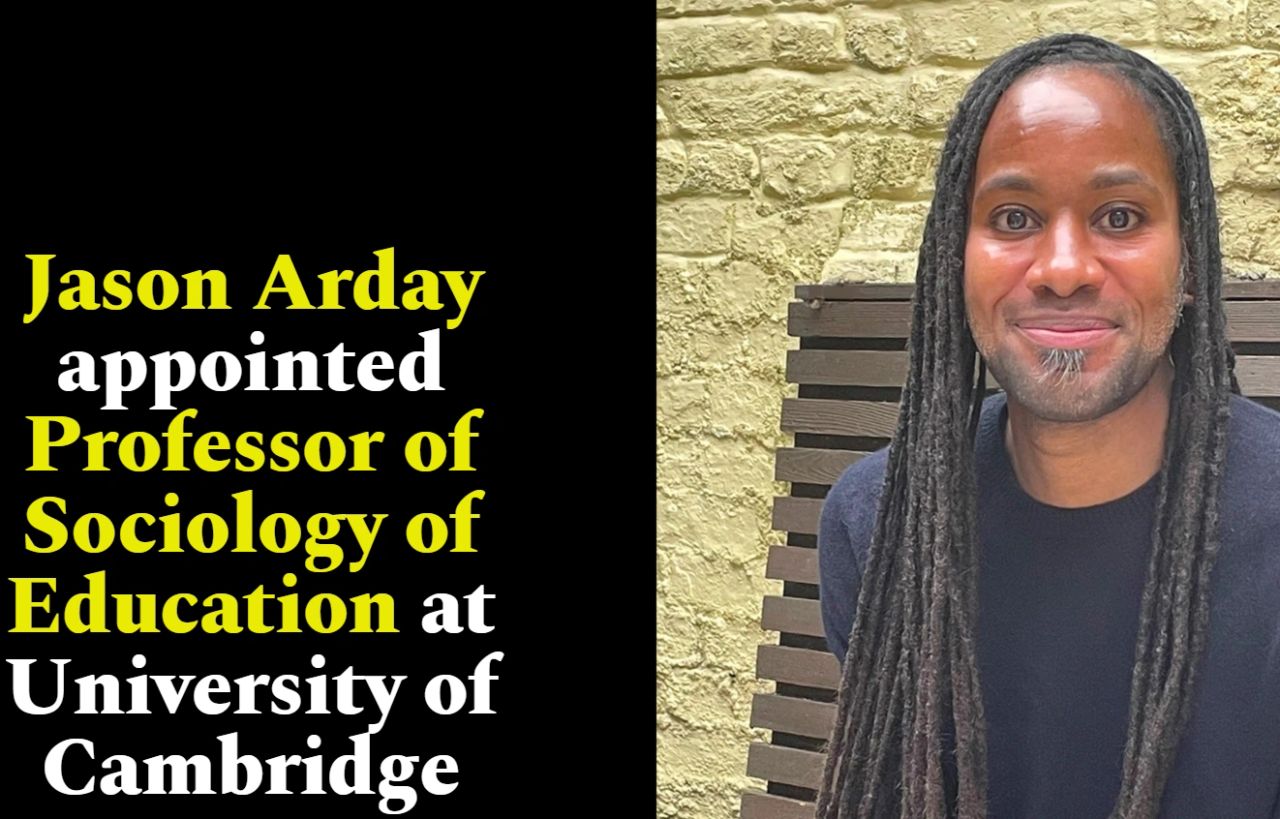
I have been glued to one story alone this week. That of Professor Jason Arday, until this week the Professor of Sociology of Education at Cambridge. You'd have to have a heart of stone not to find the comedy in it.
Arday became the youngest black professor at Cambridge University ever, at the age of 37, on the crest of a personal story of disadvantage and "overcoming the odds" that saw faculty heads swooning. A story that involved being non-verbal until 11, illiterate until his late teens, autistic, dyslexic, eventually battling through to learn to read, write and speak, obtaining the PhD and eventually being beckoned to the hallowed halls of Cambridge itself. Was there any hardship young Arday did not face, I ask myself? I've seen many clips on X in the last week, including the gushing coverage at the time of his appointment, given those circumstances. It was obviously a cause for institutional celebration.
However….it seems Arday has very much…how shall we say it…inflated his background story, which includes claiming to be a qualified counsellor (in a video I've just watched today - he claims to have studied at Birkbeck, but Birkbeck says they have no record), having appeared in the TV show "Seven Up" (an impossibility if he meant the famous TV series), having written a book, Being Young, Black and Male, of which there is only evidence for a proposal submission, having had visiting professorships at Ohio State University, Nelson Mandela University, as well as Durham University. For which there is either no record, or a material inflation of his actual duties and roles.
It doesn't stop there. Arday has at various times reportedly claimed to have run 600 miles in six days – an achievement that would literally put him amongst the top ten endurance athletes of all time. 300 miles in 3 days. 30 marathons in 35 days. Nine marathons on a fractured fibula. To have played football for Crystal Palace youth team, before playing "semi-professionally", and to have been (checks notes) a professional snooker player. I mean, wow. Whatever else, you have to admire the ambition.
Wait, there's more. He has also claimed at various points to have raised £5 million for charities (the Times, Telegraph and Guardian have all looked at the numbers and can't make it make sense), and worked overseas for WaterAid in South America (WaterAid don't actually have such overseas volunteer programmes).
It's a marvellous story with one problem. On the mountain of evidence now emerging, a huge amount of it is simply untrue, or is so skewed we might as well say the same.
The amazing thing is, even this is just scratching the surface. All of these things, Arday has willingly shared openly on various online meetings, lecture formats, supervisions, across personal websites and blurb etc. Unchallenged, and usually with a rapt audience who, with hindsight, seem a little too keen to bask in the wide-eyed romance of the backstory.
The story-telling was going just fine until the allegations of plagiarism emerged. This led to a chain reaction of people looking into him properly, seemingly - amazingly - for the first time.
Sections of his PhD thesis were reported in the Times last month as "identical or near-identical" to earlier work by other researchers, of the kind it is hard to square away as a referencing issue. In fairness, Liverpool John Moores, which awarded the doctorate, looked into it and concluded the copying was the result of honest and reasonable error. A generous finding, I'd say, and one that gets harder to accept with more dodgy claims piling up. Arday himself denies plagiarism, though he told the Times he had made mistakes, which he put down partly to a lack of supervision while he was working on the doctorate. There were also claims about being harassed on campus which contain what one newspaper describes as "inconsistencies". Cambridge University initially defended him, but changed course on 5th August, opening an investigation after the Times put new evidence to it alleging that some of his research was fabricated and contained impossible evidence. Arday resigned hours later, the same day, from the university and from his fellowship at Jesus College, writing about needing "time to heal" and promising he would "return." Cambridge, for its part, says it will carry on investigating the circumstances of the appointment and tenure, and that the findings will feed into a review of how it appoints senior academics. Some of its own academics have already said the university should not be investigating itself.
I can't lie to you, dear reader, this is pretty entertaining stuff. But there's also something much more significant to all this than one person’s claims falling apart under scrutiny (and I grudgingly respect the sheer nerve of his hustle and personally wish him well if he takes proper accountability). I see worrying variations of the same thing happening in my own profession and quite a few others.
Let's look at the institution. Cambridge got conned in a specific way that it absolutely invited. Its own announcement foregrounded his race, neurodivergence, disadvantaged background and the significance of his appointment for under-represented groups. I'd say this is the root of the problem. The desire to celebrate the story came before it was even checked.
When any institution commits itself to contested accounts of the world and holds them to be 'what decency requires', then checking - any scrutiny - becomes painful and expensive. Decolonising the curriculum, centring marginalised voices and addressing structural power are no longer simply ideas about the world. They become markers of moral seriousness. Questioning a person who visibly embodies those commitments can therefore start to look like questioning the commitments themselves. The question reads as an attack, and the person asking it looks, at best, uncharitable; at worst, actively wicked. In Arday's case, potentially racist.
In clips I’ve seen from a UCL lecture he speaks about language in a “hyper-diverse multicultural society” and, at one point, interestingly contrasts “censoring” language with “correcting” it. Hmmm…. Corrected by whom, according to what understanding of the world, and with what room for disagreement? An example of exactly how benign institutional language can hide much harder propositions. Words such as inclusive, decolonised and anti-oppressive sound definitionally good - who would argue in favour of the opposites? - but they can carry within them interpretive assumptions about human relations, people, and politics which are smuggled in, creating a hierarchy of legitimacy enforced through ‘correction’. Naturally, those who control the vocabulary get to choose which ways of speaking require correction, what form that takes, and ultimately who gets to do the correcting, precisely because the words themselves are ill-defined and soft. The propositions and political beliefs underneath them are often firm and much more permanent.
Institutionally, all of this is felt at some intuitive level. It’s this background sense of threat that means the questioning simply never happens. Or at least not by anyone who feels they have too much to lose. Academics spend a lifetime trying to get somewhere like Cambridge. Do you want to bugger it up by questioning a colleague’s work or claims? Are you willing to jeopardise your career for nothing other than the truth? Or does it suit you more to just cheer and partake in the ‘good news’ story the institution is selling? You are still free to question, but hardly anybody will as nobody wants to be the person doing it. It serves most people better to give the whole thing little thought, to wave it through celebrating the shared sense of progress. There is a chilling effect on truth-seeking of all kinds.
By the time Arday reached Cambridge, however, the thesis was there to be examined, along with all the other things that it would make sense to check.
One of the people who did look was Nathan Cofnas, a former Cambridge researcher. He published comparisons between passages in Arday’s thesis and earlier work which he argued showed plagiarism - I’ve seen the examples, and can’t imagine how this got through actually. I know little about Cofnas beyond his involvement in this story, and don't particularly need to. Cambridge’s response to the allegations at that stage was to say that Arday had been the victim of a “vile campaign to undermine his credibility”. Only later, as the questions accumulated, did the institution itself change tack.
The fundamental mistake is allowing the symbolic value of any person (of any background) to become a kind of evidential 'free pass'. Arday didn't really arrive as an academic with a CV, but as the embodiment of things Cambridge already believed were important: structural disadvantage overcome, barriers broken, representation achieved. And that is precisely when the boring questions become vital. Many people simply decide to self-edit, and so institutional edicts forbidding questions are not needed. The institution can remain (generous interpretation) full of intelligent, conscientious people while becoming oddly stupid in one particular direction.
I've written about this pattern a lot this year as I think my own profession is making the same structural mistake. BACP's new Ethical Framework makes anti-oppression a distinct ethical principle. I'll be writing about this much more soon, but I suspect the fallout will eventually prove significant, as happens when any contested way of understanding people is given ethical status over others. Nash Popovic and I asked BACP to preserve explicit theoretical pluralism - the principle that more than one legitimate way of understanding a person must remain available - and they've declined to do so and refused to allow a resolution to go to members on the topic. Obviously I'm not comparing that with plagiarism or invented qualifications. The connection is structural. Once a particular account of the world becomes part of what an institution believes a good person ought to believe, asking questions about that account becomes too damn costly for anyone asking them. Most simply won't. That is the Cambridge problem in miniature, and I think the therapy sector will discover the cost of it in its own way.
Back to Arday. I want to say something about him personally.
To be honest, I already feel a bit sorry for him as I write. Many people have told a fib or two on their CV, especially when young, but poor Arday seems to have been swept away in it all. I've watched another of his lectures, 40 minutes solid talking without saying a single thing. It's a definite skill and handy in politics, but nowhere is it found more than certain university courses. The whole time is spent talking about the great need and importance of talking about A and B because it is "not talked about enough"… then pivoting immediately to say it's important we also talk about C and D because they are important too (and moving up the alphabet). There's so much talk about what it's important to talk about… that the actual talking about it part never arrives. But he is smooth in delivery, has enough "you know's" and humble-isms to get an audience on his side, and has a decent sort of modest energy with a big back story. I can certainly see the appeal in terms of presentation, even though the lecture I watched was pure flannel. I suspect a lot of his outlandish claims may have started as exaggerations of something true, which without the exaggerations would still have been a hell of a story. It's a shame. In all honesty, he looks like someone who found an environment that would cheer on his narrative rather than ask anything about it, and then behaved as people do in environments where they can hardly believe their luck. He just enjoyed developing his own legend while even some of the finest minds in the land clapped wildly with teary eyes. The personal failure belongs to him. Hard to throw stones, but he must own it. The greater failure is the institution's. It had arranged itself in such a moral stress position that his story couldn't be checked without appearing to attack what his story had been made to represent.
His resignation statement has the quality of a person who doesn't entirely understand that the game is up. Even at the moment of collapse, the words are the vocabulary of the same framework. The Healing, Injury, and promised Return. A good ending for a chapter in his mystery book.
Institutions, I worry, don't learn from single episodes like this. More likely they learn from cumulative embarrassment across many episodes. Somewhere right now, there's a similar figure being celebrated at a similar institution, whose background contains claims that no one has got round to checking, because checking would look uncharitable and be risky. That figure will be exposed, in due course, by somebody already outside the moral community with nothing left to lose. The institution will call it a vile campaign. Then it will open its own investigation and sort out the media strategy. Then it will probably just continue.
No philosophy is made true by being attached to the right person, no matter how morally moving the person's story. The evidence and reasoning still have to be checked, and the claims still have to survive scrutiny. Any institution that arranges itself so that scrutiny becomes structurally difficult is arranging itself to be embarrassed sooner or later.
----------
Steve Perkins is a psychotherapist and clinical supervisor in private practice in Shoreham-by-Sea and the City of London. He is the author of Moral Singularity: Life Inside Closed Moral Worlds and Why Moral Conversation Breaks Down.


Comments
Post a Comment