The Further Away You Are, the More Certain You Get...(3.5.26)
Distance & Certainty...
I sit with people for a living. An hour at a time, several times a day, listening to the inside of someone’s life. Selecting one day from last week, I had conversations about a marriage that is failing but might not be, another about a big decision that looks obvious from the outside but is not obvious at all once you are close enough to see what it would cost, and a parent who loves their child and is also, in ways they are only beginning to understand, making things worse for their child.
None of these situations have clean or simple answers. What they do have are trade-offs, and those trade-offs have serious costs, and sitting with that weight without rushing to resolve it is actually most of what I do.
When finished, like millions of others, I'll probably plonk down in a chair and open my phone at some point. And there (on X) I invariably read someone explaining with complete confidence what people in these kinds of situations should do.
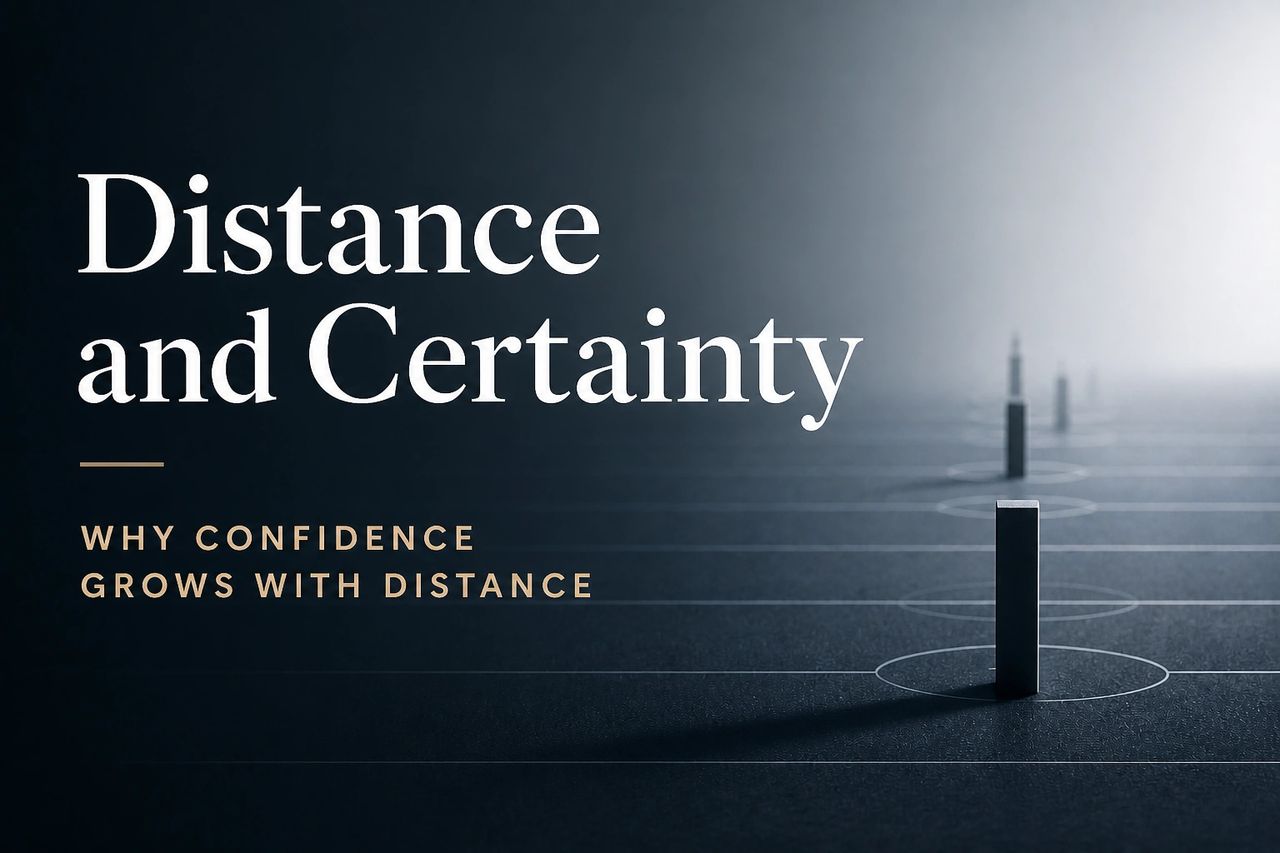
I now notice this gap constantly. The person in my room is uncertain, conflicted, unable to see clearly because they are inside the thing. The person online with the expert opinions is fluent, organised and certain - it's all so obvious and easy... I've started to think that this is not a difference in intelligence or insight. It is a difference in distance. Maybe there is a law of nature operating: the closer you are to something, the harder it is to be certain. The further away you are, the easier certainty becomes. And I am no longer sure that the certainty is the more reliable of the two.
I should say plainly that excess certainty is something I too am guilty of. I suppose we all are at times. In fact I recently caught myself demonstrating this kind of simplistic certainty, whilst also being quite wrong, in a way that struck me.
I was reading about a humanitarian crisis in a part of the world I have never visited and know very little about. The reporting was distressing and the images were awful. I noticed, with discomfort, that I had strong and well-organised views about what should be done, who was responsible, and what the right response would be. My views felt clear indeed. They also felt morally serious. And they had absolutely no hesitation or friction in them. No sense of what it would actually mean to be inside that situation rather than reading about it on a screen. I was certain in a way that I never am about the things I actually work with, and the certainty felt good. Not thoughtful-good. Righteous-good. Case-closed-good. The kind of good that should come with a warning. Because that is what distance does. It strips away the resistance and space that normally slows judgement down, and what is left feels like clarity.
When you are closer to something, friction is everywhere. You are dealing with competing needs, with emotional weight, with information that contradicts what you thought you knew, with consequences that crash into you whether you are ready for them or not. All of this makes certainty difficult, because the situation genuinely contains more than one valid reading and you are close enough to feel the pull of each one. Proximity may not make you wiser, but the chances are it makes you slower, which is a natural response to the true complexity that is actually there.
When you are far from something, peering into a screen, all of that disappears. You are working with a cleaner version of the situation, one stripped of the mess that proximity forces you to deal with. Your mind does what minds do with clean inputs: it finds a pattern, builds a coherent story, and stops there. The settling feels like understanding. I have started to think that a lot of what passes for moral clarity is actually moral distance, and that the two feel so similar from the inside that most people never learn to tell them apart.
Once you have settled on a view from a distance, nothing pushes back. You don’t encounter the consequences of being wrong because you are not close enough for consequences to reach you. Your model never has to survive contact with what it describes. So certainty not only forms at a distance, but it hardens there too. Because the one thing that would soften it, contact with the reality you are describing, is precisely what distance removes. I have written elsewhere about what I call conviction cascades, positions that people come to hold through ease of uptake, rather than evidence. Distance is another route to the same destination. A view that forms without friction will be held with the wrong kind of confidence, whether the friction was removed by social pressure or by the simple fact of being far enough away that nothing hurts.
Speaking for myself, the opinions I hold most cleanly are almost always the ones I have never had to act on. The situations I find most morally clear are usually the ones where I have never had to sit with someone who is inside them. When I catch myself being certain about something I have no direct experience of, there is a small moment of embarrassment followed by something that I flatter myself is more useful: a suspicion about the certainty itself. The view I feel certain about needn’t actually be wrong. Sometimes distant views are correct. But the quality of the confidence is different from the confidence I have about things I know well.
I think about this with my clients too. The people who come to see me are close to their problems. Tangled in them, and unable to see clearly because they are inside the mess. And I sit at a slight distance, which is what allows me to see patterns they cannot see. So that kind of distance is useful and is part of what makes therapy work in the first place. But it is also dangerous if I forget that my clarity is partly a product of not being the one who has to live with the consequences of whatever pattern I might spot. The client who is struggling to leave a relationship is not failing to see what I can see. They are seeing things I cannot see, because they are close enough to feel the weight of what leaving would actually mean. My distance gives me perspective. Their proximity gives them something I do not have, which is the full texture of what it is like to be inside the thing I am observing from outside.
I'm not suggesting that proximity is always right and distance is always wrong. That would be another oversimplification, and I have seen enough clients distorted by proximity to know that being inside something can blind you just as effectively as being outside it. But I do try to develop the habit of checking. When I feel certain about something, I try to ask how close I am to it. Is this clarity, or is this just.... cleanness? Am I seeing something real, or am I seeing something simple because I am far enough away that the complexity has not reached me yet?
It is a small question, maybe. But an important one. It changes the quality of the confidence, and in my experience, that is usually where the better thinking starts.
---
Steve Perkins is a Consultant Psychotherapist and Clinical Supervisor in private practice in Shoreham-by-Sea and City of London. He is the author of Moral Singularity: Life Inside Closed Moral Worlds and Why Moral Conversation Breaks Down (2026), and writes on therapeutic enclosure, conviction cascades, the interpretive ratchet, and the structural dynamics of closed moral systems.
MBACP (Accred)
www.whitestonetherapy.com


Comments
Post a Comment